Tuesday, March 22, 2011

Tokyo Food Adventure #3: SUSHI

After much anticipation and much restraint in not eating sushi my first 2 nights in Tokyo, the day finally arrived. Today would be the day that changed my perception of sushi forever! Numerous have raved about this tiny little sushi bar in Tsukiji Fish Market in Tokyo, so I had to see for myself. I must warn you, this meal does not come with a price. The requirement was that I had to get up before the crack of dawn and drag myself through the Tokyo train stations, find this place, and hope that there would be no line up that morning. I gave myself false hope thinking that it was a week day and there would be less of a line, wishful thinking is all I can say. So, here is how my adventure started.

Catching an early morning train. While everyone sleeps, I armed myself with my Kindle to ensure that I didn't miss my stop.


6AM on the dot, and not a minute later, I arrive at Tsukijishiko Station, located just outside the fish market.


After a quick stroll through the fish market at a quickened pace, I finally arrived at the coveted Sushi Da.


To my dismay, I was greeted by a mob of people who were even more determined then I to beat the line, and was quickly told that the end of the line was around the corner and NOT in front of the restaurant. This would be what I had to stare at for the next hour or more.


An hour later, I rounded the corner, and still I was so close yet so far! As you gain sight of the door, an old lady then comes to you asking which combination you want to order. There are 2 options, I went for the Omasake (chef's choice) menu, which I'd have to wait for another hour to actually enjoy.


And as I waited, temptation passed me by as I saw giant tunas being hauled through the streets.


At this point, I was starting to itch with excitement and anticipation. I was also at the same time starting to loose my patience along with the feeling in my toes from the long standing period and the cold. Just as I though I couldn't wait any longer, the doors were opened, people flowed out, and I was finally invited in! As I sat down, I looked at my iPod, it was 7:22AM, I had been waiting for nearly an hour and a 1/2, and the song title of the song playing could have potentially summed up what I felt as I was sitting down in 1 word.


As I sat down, the sushi chef cleaned the bar top to ensure as he said it himself "sanitation".


As he started to prepare the meal, I was told that this sushi shop is now 80 years old, and the young looking chef himself had worked there for 20. I guess my meal was in good hands then. So here it goes.

First, a small mound of ginger is placed in front of you, this you are able to ask for more of as soon as you run out. It had a light, sweet, slightly warm taste that was un-intrusive to the food to come after.


Well, usually you would think to save the best for last, but this places really knows how to start things off with a bang! First up, O-toro. Absolutely the most deliciously tender, melt in your mouth, buttery texture of tuna that you will get your hands on. I was in love. Normally speaking, I love my sushi with quite a decent amount of wasabi in partnership with soy sauce. I will admit, this piece of fish needed no help, and not to mention the shine and marbling on the meat. Mesmerizing and indescribable, party in my mouth!


Miso soup. Rich in flavour, portions of fish and bone still in the soup. The dark miso had a slight saltiness which was balanced out with the light sweet flavour of miso. Great to warm up with after standing out in the fridged cold for 1 1/2 hrs.


Next on the list was flat fish. I was instructed to take this fish in 1 bite as it had sinus in it and would be hard to bite through in smaller bites. Would not have been my first pick of fishes to eat, but not bad considering.


And along came the red snapper. Another absolutely beautiful and eye catching piece of fish. The firm flesh of the meat was absolutely delicious with it's slight sweet and salty hints. As it was already brushed with a thin layer of sauce, it needed no help from the wasabi and soy duo.


For those of you who think that uni is a gooey, fishy tasting thing, you have not had real uni. This was a moment of bliss. The tender melt in the mouth texture of this uni, paired with is mild sweet, slight saltiness was to die for. There are no words to describe the perfection of this uni in one bite.


According to the Japanese, you can tell a sushi chef's skill by the tomagoyaki he makes. And this, was a perfect blend of saltiness to mild sweetness. Tender, fluffy, hot off the stove, perfection.


The Japanese do love their tuna. Tuna to them, is like salmon sashimi to the average American, a must have. But this tuna was not the typical tuna that you get at a North American Japanese restaurant. It was vibrantly red, absolutely tender meat, with no sinus at all. Paired with a hint of freshly grated wasabi and glazed with light soy, even for me (tuna is not my first choice of fish), I had no complaints. It was absolutely delicious.


Now, surf clams usually generate the image of a piece of sashimi that is red in colour, rubbery in texture, and relatively tasteless in flavour. But this, this definitely changed the idea of surf clams in my mind. First of all, it was still moving as it arrived on the sushi bar in front of me! There was absolutely no redness in colour, and no rubbery texture. It was a natural looking cream colour, delivered a crunchy texture, and tasted sweet and mildly salty like the ocean. Delicious once you get over the fact that it's still moving.


Now horse mackerel is something that I've never tried. Stunning colour and presentation, firm in texture. The texture was more similar to that of salmon than tuna I would say. Definitely the fishiest tasting of the fish served so far. Yet it still had a clean, oceany taste. The hint of marinated green onions on top balanced out the flavours perfectly. I have to say, I quite liked it, but have not seen anything quite like it before at Japanese restaurants.


When it comes to sweet shrimp, they are one of my favourites as sashimi. These baby shrimps on maki were not quite the same though, a much softer texture, and a much milder flavour. There was at least a dozen shrimp on this one piece of sushi. Although not particularly memorable for me.


Spanish mackerel delivered a more tender and lean texture than the horse mackerel. Though it still contained a slight amount of fattiness that allow a balance in texture.


After all the maki, if you aren't already as stuffed as you can be at 7 in the morning, there are tuna and cod rolls to assist with that.


Lastly, steamed eel with sweet soy was presented. Generally, I'm not a fan of eel, but this was not your typical eel. It was tender, flavourful, not too salty, a mild sweetness. Absolutely delicious. Perfect way to end the meal.


And when you think you couldn't get any fuller, the chef hands you a menu to choose a piece of sushi of your choice. You can either go back and have something that you've already had, or try something new.


At the recommendation of the chef, I decided to try the yellowtail. This was the biggest piece of yellowtail I'd ever seen. It was the size of 1/2 my palm. So big that the ball of rice was lost beneath it. Topped with wasabi, sweet soy, and julienned green onion. The texture was firm, tender, deliciously balanced in flavour. Perfect way to end the meal.


By the time I was finished, I could barely move. Never have I imagined I could be so full at 7:30AM. Time to walk it off in the fish market and go on a hunt for goodies.

Tuesday, March 1, 2011

Tokyo Food Adventure #2: SEAFOOD

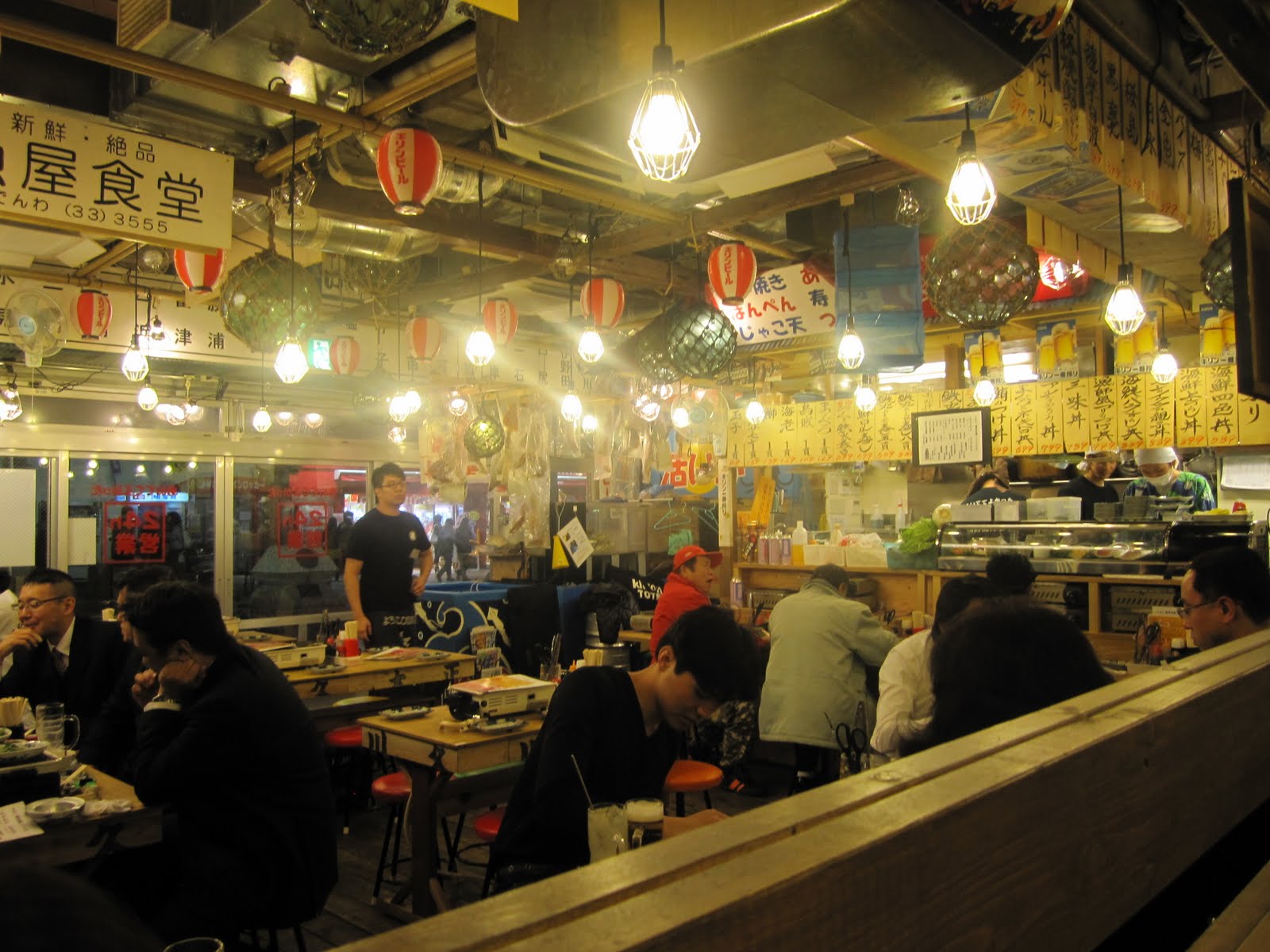
After my morning adventure into a local udon shop, I was craving for the next thing that came to mind in my list of things to eat in Tokyo, Izakaya. Lucky for me, I had a friend in Tokyo to be my tour guide for the evening and didn't have to adventure out on my own for this one. The plan was to take a tour of Shinjuku, then go on a search for a good local izakaya place for dinner. Yet, as we walked through the streets of Shinjuku, my eyes were drawn to the fish tanks filled with fresh seafood.


Walking into the restaurant, there were regular tables with little metal stools to sit on, but also an area with tatami mats. Since I was in Japan, I had to opt for the traditional seating.


After looking through the menu and pictures on the wall, there was only one thing that I absolutely HAD to try. So, I left the rest of the ordering up to my lovely tour guide for the evening. This is what we managed to spoil our palates with.

To start off with, we were in Japan, in a seafood barbeque place. We couldn't exactly leave without having at least 1 Japanese beer. So, we started off the meal with a nice pint of Kirin. I may have been a little thirsty, so I took a sip before pictures were taken.


Next came the large cubes of fresh tuna, and uni maki. I tried to resist any form of sushi as I was planning on going to the fish market the next morning, but the temptation was just a little much.


Even the most mediocre grade of tuna in Tokyo tasted absolutely amazing! Mmmm...


It was then time to utilize the grill. The waitress came over to teach my tour guide / personal chef for the night (Ron), how to grill the seafood. Here is what we ended up with.


The scallops were absolutely delicious. Fresh, plump, tender scallops with the briny flavour of the ocean in the juices that came out of it.


Next was the surf clam. It was slightly tough in texture for my liking. The juices that came out of the surf clam were also slightly saltier that I would have liked, unlike the well balanced salty / sweet flavour from the scallops.


This was a perfectly baked fish. Not overly cooked and dry on the inside. Instead, the flesh was moist, tender and had a sweetness of fresh fish.

I was relatively full at this point, but I had 1 more thing to eat before I left. To save the best for last, I had already tried this as the second dish of the meal. As stuffed as I was though, I had to order a second helping of it, even if it meant having to unbutton my jeans!


Last but not least, the crab shell licking good, Kani Miso. I drool at the thought of this. Although those of you who have not tried it may be grossed out at the thought of it, but the insides of the crab (everything aside from the meat), are often enjoyed in Asian cuisine. It brings a delicious balance of sweet, creamy, briny flavour to your palate. This was exactly what this dish was. A mixture of creamy, sweet, slightly salty flavours of the inside of the crab, mixed with bits of crab meat that brought out more sweetness in flavour. Now THIS, it something that you must try once in your life! It was a party in my mouth. Or, what some would call a food orgasm. Right there and then, I was in love!

Conclusion, I would give up Izakaya for one of these delicious crab shells filled with Kani Miso again any day! Great end to a day of food exploration. That, along with the yuzu / plum wine definitely made my day!

Wednesday, February 23, 2011

Tokyo Food Adventure #1: UDON

After bidding my farewells to New York and spending a food and alcohol ridden week in Taipei, I decided to take a break from the madness and book a ticket to Tokyo. Realistically though, if it hadn't been for a friend who conveniently was going on a business trip and had a hotel room that was a 5 minute walk from Shinjuku Station in the heart of Tokyo, I probably wouldn't have booked a ticket and left the next day. Fortunately for me, I had a justification for this trip because it'd be like giving up a free ticket if I didn't hop on the plane.

While booking my ticket, it was decided that I would make this a food adventure in Tokyo that would not be easily forgotten. I would go on a hunt for all the things that Japan is most well known for: sushi, ramen, udon, and beef, amongst other things that I happened to come across. I must admit, having planned to arrive Sunday night and leaving Thursday morning meant not much time for more food than I could fit into my stomach.

Monday Morning
Having had a rough week in Taipei and still trying to recover from jet lag, I opted out of going to the Tsukiji Fish Market my 1st day there. I slept in a little and got some good r&r, the woke up to my stomach growling at me calling out for food. I threw on some clothes and set out on a hunt for my 1st meal in Tokyo. Well, here I'll admit, the previous night after landing, we had already ventured out for some food, and I had scarfed down an amazing bowl of ramen in no time. So, on the search for food, I decided to head to the same area (5 minute walk from the hotel), in search of some authentic Japanese food.

When arriving at the Shinjuku Station, if you walk out and hang a right, walk approximately 5 minutes, cross a major intersection and turn into the 1st small back street, you will find yourself in a couple blocks filled with restaurants with very few foreigners. This is exactly what I was looking for. These were my only 2 requirements: no sushi (that must be saved for the Tsukiji Market), and a place with few or no foreigners (I was looking for something authentic. Simple enough you might say, there's plenty of options aside from sushi in an area with few foreigners. Only trouble with that was, ALL the signs and menus were in Japanese! I had no idea as to what the restaurant was selling, and how I would order anything unless there were big vibrant photographs of the menu outside.

After wandering aimlessly for an hour and not understanding a word on the menus, I finally decided to walk into a tiny noodle shop. Luckily my limited knowledge of chinese came into good use, because some Japanese characters are the same as Chinese characters. Although, I still didn't know what kind of noodle shop it was. For all I knew, it could have been a ramen, soba, or udon shop. I decided to take my chances.


Walking in, it was a cute little shop with a noodle bar and tables, all locals no foreigners. Bingo, I landed in my authentic affair that I was in search for.


Since I was there on my own, I was quickly directed to the noodle bar which was seated by mainly Japanese men in black suits on their lunch breaks.


I asked the waitress hoping that they would have an English menu. Lucky for me they did! According to the menu, small, medium and large bowls of Udon were all the same price. 700yen for either 200, 300, or 400 grams of udon noodles, and a bowl of dipping sauce on the side. But as with any good noodle place in Japan, I had to order the perfectly soft boiled egg with the creamy center! Along with that was some pork "cha sui" and bamboo. All that for an extra 300yen. I was so excited I could hardly contain myself! Soon enough, I had more food then I could imagine sitting in front of me.


As I was waiting for my noodles, I carefully watched those around me eating their bowls of udon as it wasn't the typical bowl of udon that we're used to in North America. Instead of a bowl of udon in soup, I was served a bowl of unseasoned, dry udon. As I watched the man next to me, I figured out the Japanese way of eating udon. A bowl of sauce on the side is used for dipping your udon in. So this is how it was done.


After making my way through 1/2 a bowl of udon, I had to admit defeat. There was way too much noodle, pork, bamboo and egg to fit into my stomach. What I didn't know was at the bottom of the bowl of sauce, also sat a good amount of pork and bamboo. I could barely move at this point.


As I sat there attempting to digest this large amount of food, I started to wonder what the second pitcher contained in front of me. I knew one was filled with water, and then other... tea?


I watched as other people finished up their meal and realized what the second pitcher was for.


The second pitcher is filled with hot water for you to make your own soup after finishing your udon with the left over dipping sauce. PERFECT, especially on a cold winter day.

After my bowl of soup, my tummy was filled and I was ready to go for a nice long walk in attempts to digest all this food. All this yummy goodness only added up to 1000yen (approximately $10CAD). Worth every penny of it I must admit! This meal left me craving another bowl of udon for the rest of my trip!

Thursday, February 10, 2011

My Time w/ the Frenchies

Where to begin?

Since the last blog, I bid my farewells to Australia, moved to New York, enrolled myself into the French Culinary Institute, graduated from culinary school, and now on to the real world (well, maybe after my trip to the motherland). So, I guess we'll start with my culinary adventure through culinary school.

Admittedly, the decision of going to culinary school wasn't exactly a walk in the park for me. From no experience in culinary whatsoever, to enrolling myself into a full-time, 6-month program in classic French culinary arts was a big decision. Although I've always had an itching to go to culinary school, after already having moved across the world to attend Le Cordon Bleu in Australia for their restaurant management program and being thoroughly disappointed, I didn't want to find myself in the same predicament again. In the end, the decision was made, bags were packed, tickets were booked, and there I was, wide-eyed and lost in the Big Apple, all alone in a new city once again.

Prior to my decision in enrolling myself at the French Culinary Institute, I did some research into other top ranking schools for culinary arts in North America. Although 1/2 the world away and not being able to visit the schools, I did have the help of the internet. The schools in consideration: CIA (The Culinary Institute of America), LCB (Le Cordon Bleu), and FCI (The French Culinary Institute).

CIA
Known across North America as being one of the top culinary schools, the CIA's program is a 2 year program. Having already done an undergraduate program, then spent 6 months in Australia for school, I wasn't ready to once again invest 2 years of my time in school. Location was also a factor, their campus is not located in a city, therefore reduces opportunities to head out and explore new restaurants (although, great location to focus on academics).

LCB
Let's face it, after having moved across the world and being thoroughly disappointed by their management program, i wasn't exactly ready to invest more time and effort into their school. Although, I did enrol in their management program and not their culinary program for which they are known for.

The Winner: FCI
Also recognized across North America as one of the top culinary programs, short 6-month intensive program (which meant that I wouldn't be in school till I was in my "late 20's"), AND it was located in the heart of Manhattan (culinary capital of North America). What more could I ask for?


The program at the FCI was split into 6 levels, hence, each level consisting of 1 month of classes (Mon - Fri, 9AM - 3PM).

Level 1
Most people that enrol are career changers coming from various different backgrounds. Therefore, they start off with the basics. First off, you learn the basic cuts of vegetables and cooking methods. They then introduce you to essentials such as making stocks, sauces and binding agents. Which brings you into some simple soups as a result of your lectures on stock making. Then you move on to preserved foods: gravlax, duck confit preserved fruits and such. Next comes salads and potatoes (learning how to make potatoes in 8 different methods in 1 day).


After this, comes the good part, MEATS. Starting off with seafood and shellfish. First you learn how to filet fish, both round and flat fish. Then, you get a whole day of shellfish, from lobsters, scallops, clams, to oysters. The full 9 yards.


To conclude the level, poultry (chicken, duck, quail), beef, pork and lamb.


Level 2

Level 2 starts off with an introduction to game meats, veal and organ meats. Organ meats definitely was not my favourite of days. Followed by a whole day of eggs. Baked eggs, poached eggs, omelettes, devilled eggs. Every type of egg imaginable. By the end of the day, the thought of eating another egg was slightly, nauseating.


Next, comes a week of pastries. For those with a sweet tooth, this week is god sent. Souffles, ice creams, sorbets, mousses, profiteroles, tarts, crepes, all though you could wish for.


Lastly, lessons on cheese, pasta sauces, and pasta making to conclude the month.


Oh, of course we can't forget the full day wine lecture that includes wine tasting in a method that I had never previously thought of. Also, a day to allow you to flex your creativity on your final day. You are given an opportunity to make "flounder your way", using any ingredients readily available that day.

Level 3

Level 3 is a test of time, skill and efficiency. Taking your already developed skills in the kitchen, and putting a time limit on when the dishes must be completed. You rotate between garde manger, saucier and pastry dishes. Each day, they tighten the reins ever so slightly to push you to work faster. You are given new dishes each week once you've rotated through each dish for the various station.


Level 4

Level 4 is based on large quantity production and cooking. Eight days are spent in each of the following areas: production, buffet and family meal.

In production, the focus is primarily on large scale production of stocks (chicken, veal, marmite, etc.) for in house use, breaking down various animals and fish (rabbits, chicken, ducks, pork chops, etc.), and if time allows, working on side projects such as smoked bacon, sausages, canapes, etc.

Next comes buffet. In buffet, each team chooses a theme for a buffet in which they will produce a buffet lunch for approximately 100 - 150 staff and students. This involves researching your own recipes, and creating dishes that relate to the theme.


Final rotation is through family meal. With family meal, you are producing lunch for all the students and staff in the building. This, like production, is a fairly labour intensive rotation. Although dishes and recipes are relatively simple, everyone must work fast in order to meet the deadline of 12PM where staff and students line up to grab some grub.

Levels 5 & 6

This is when you actually get to work in the restaurant kitchen. You rotate through the various stations in the kitchen on 4 day rotations. Although great experience for one who's never been in a real commercial kitchen, it is not a realistic representation of how an actual restaurant kitchen is run. You have 4 to 5 people doing the work of 1 person. All in all, a good experience for a non-experienced cook.


In conclusion.... Was culinary school worth it?

Here is what I have to say to that question. The French Culinary Institute is only worth as much as the effort that you are willing to put in. Although the program is great for giving you a basic understanding of food, and the functions in a kitchen, the value of the program really does lie within the networks that the school is able to provide. The more willing you are to dedicate your time and energy to the program, the more opportunities, companies, chefs / celebrity chefs, you will be exposed to. Thus, enhancing your learning experience at the school. For those who aren't 100% sure this is what you are passionate about and want to pursue, I would say that this may not be the right decision for you. For me, it was an absolutely amazing 6 months and I wouldn't trade it in for anything.